
Understanding Absurdism
Absurdism is a philosophical perspective that emerged in the 20th century, largely influenced by the works of Albert Camus. It grapples with the inherent conflict between humans’ desire to find meaning in life and the indifferent, chaotic universe that offers no definitive answers.
This tension leads to what is often referred to as the “absurd condition.” The recognition of this absurdity does not lead directly to despair; rather, it prompts individuals to embrace the absurdity of existence.
Unlike existentialism, which posits that individuals can create their own meaning, it acknowledges that such an endeavor may ultimately be futile. Existentialists such as Jean-Paul Sartre argue that humans have the freedom and responsibility to carve out their own essence, whereas absurdist’s like Camus, suggests that this quest for meaning is inherently absurd. It is crucial to understand this distinction, as absurdism offers a different viewpoint on how we navigate life’s inherent contradictions.
Nihilism, on the other hand, takes a more arguably pessimistic approach, positing that life is entirely devoid of meaning. Absurdism rejects this notion by affirming the human experience as valuable despite its lack of inherent purpose.
Also, Before we begin, please note that all of the links to books below HEAVILY support my blog and my efforts to help expand the accessibility of this information to everyone.
I do this all by myself.
Any/all support, whether it be your sharing on social media, purchasing through any of my affiliates, or even commenting here is GREATLY appreciated, beyond what I can express in this post.
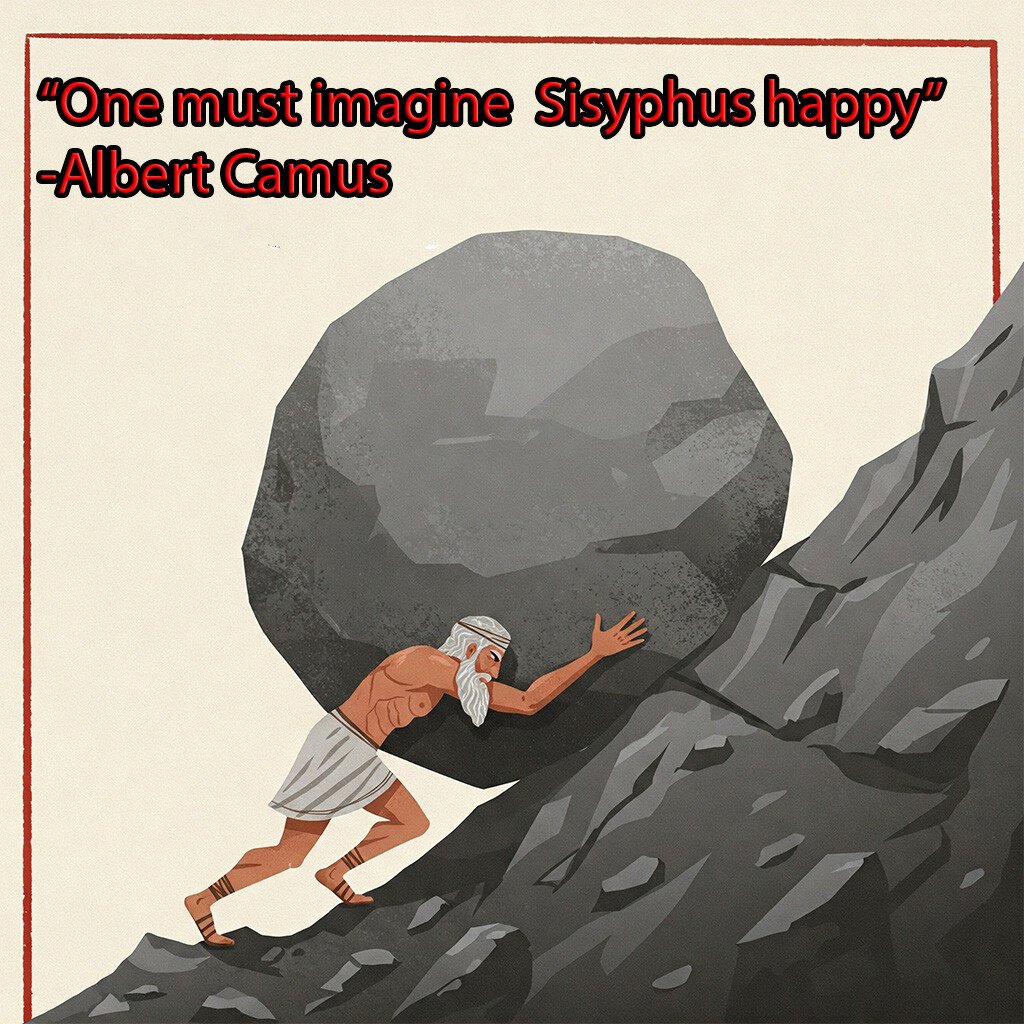
Camus famously wrote about the “Myth of Sisyphus” wherein Sisyphus is condemned to roll a boulder up a hill only for it to roll back down repeatedly.
Through this allegory, he illustrates that acknowledging the absurdity in life allows individuals to find personal significance, even amidst futility.
This grants us a uniquely compelling framework for understanding human existence, encouraging individuals to confront the absurd instead of surrendering to despair.
Core Beliefs of Absurdism

Absurdism posits that human existence is inherently devoid of meaning and it is entirely Absurd. Central to this philosophy is the recognition that individuals continuously seek purpose in life despite the universe’s indifference to their struggles. This fundamental tension between the human desire for significance and the reality of a chaotic, indifferent universe forms the crux of the philosophy.
One of the key tenets within is the acknowledgment of life’s inherent meaninglessness. Human beings instinctively yearn to understand their place within the cosmos and to construct narratives that impart significance to their experiences. However, it challenges this expectation by suggesting that the universe’s silence offers no answers, leaving individuals in profound disillusionment. This realization can invoke a spectrum of emotional responses, anything ranging from despair to even empowerment, as it forces people to confront the limitations of their existence.
Alongside this theme is the human struggle to find meaning despite the overwhelming nature of life. This struggle can lead to various reflections on what it means to be human. It emphasizes that personal freedom is essential, allowing individuals to navigate an indifferent world by making choices that align with their values and desires. Embracing this freedom encourages individuals to create their own meaning, fostering a sense of agency in an otherwise chaotic existence.
Ultimately, accepting the absurd can serve as a liberating experience. Rather than succumbing to nihilism, absurdism invites individuals to confront the meaningless nature of life with courage and to find fulfillment in the pursuit of personal freedom and individual expression.
Famous Authors of Absurdism

Albert Camus is often regarded as the symbol of absurdist thought.
Born in Algeria in 1913, Camus developed a philosophy that emphasizes the inherent meaninglessness of life and the human struggle to find personal significance.
His most popular works, such as “The Myth of Sisyphus” and “The Stranger,” directly address existential themes, ultimately illustrating the acceptance of the absurd condition of human existence.


Samuel Beckett is another name to keep in regards to it’s development, particularly within the realm of theatre. Born in Dublin in 1906, Beckett’s works, including the iconic play “Waiting for Godot,” challenge traditional narrative structures by laying bare the futility of human actions and communications. His characters often find themselves in hopeless scenarios, echoing the sentiments of absurdist philosophy, which posits that life is without clear purpose. Beckett’s contributions greatly expanded the scope of absurdist expressions and significantly influenced modern theatre.
Eugène Ionesco, a Romanian-French playwright, is also a notable contributor in the world of literature. Born in 1909, Ionesco is best known for his plays like “The Bald Soprano” and “Rhinocéros,” where he gives us illogical scenarios and nonsensical dialogues to which are meant to critique societal norms and the absurdity of human communication. His work highlights the breakdown of language and the alienation of individuals in a rapidly changing world. This approach not only reinforces the core tenets of absurdism but also has a commentary on its relevance in our conversations today.
These authors, among many others, have expertly shaped the understanding of absurdism in art and literature, leaving their mark forever on it.
Key Works of Absurdism Literature

We’ve talked about it as a philosophical movement, wherein it explores the conflict between the human tendency to seek inherent meaning in life and the indifferent universe that offers none.
HOWEVER, This provocative theme is skillfully illustrated in several key works of literature.
Among the most notable is of course Albert Camus’ ‘The Stranger.”
It’s novel that encapsulates the essence of it brilliantly.
The protagonist, Meursault, experiences life as devoid of purpose, leading to a series of events that culminate in his trial, not for the murder he commits, but for his emotional detachment.
This narrative allows for people to ponder the implications of absurdism, raising questions about moral values and perhaps gives them a bit of time to sit on the situation present and try to figure out exactly why everything happened as it did… seemingly for no real reason.
While it is also considered a remarkable existentialist work, it cements itself in Absurdist literature effortlessly.
Another significant text is Camus’ ‘The Myth of Sisyphus,‘ that I talked about earlier.
He presents the famous Greek myth as a metaphor for the human condition and it has truly kept staying power in popular media even to this day.
Sisyphus, condemned to roll a boulder up a hill only for it to roll back down each time he reaches the top, epitomizes the struggle against the absurd. Camus famously concludes this essay by stating that “one must imagine Sisyphus happy,”
This powerful ending highlights the inherent value of perseverance, despite the futility of existence, making it a fundamental aspect of absurdist philosophy.
Samuel Beckett’s ‘Waiting for Godot’ further embodies absurdist themes through its exploration of existential ennui and the human experience.
The play features two characters, Vladimir and Estragon, who engage in seemingly meaningless conversations while waiting for someone named Godot, who never arrives. This cyclical waiting encapsulates the absurdity of life, encouraging audiences to reflect on their own existential dilemmas.
Together, these works form a foundational understanding of absurdism in literature, illustrating its pervasive influence and prompting further exploration. For readers interested in delving deeper, works by authors like Franz Kafka and Eugene Ionesco are excellent recommendations to expand their understanding of absurdist themes.

Absurdism in Theatre explained further
Without any doubt, there is significant expression of these themes in theatre, it’s a grand platform where the irrationality of existence and the futility of human action can be explored expertly. Notable playwrights such as Samuel Beckett and Eugène Ionesco were pivotal in bringing this philosophy to the forefront of dramatic literature. Their works challenge conventional narrative structures and character development, emphasizing the absurd nature of life.
One of the most distinguished examples is Beckett’s ‘Waiting for Godot,’ a quintessential play that revolves around two characters, Vladimir and Estragon, who wait indefinitely for a figure named Godot. The play employs minimalist staging and repetitive dialogue to reflect the existential predicament of the characters. Through their interactions, it underscores themes of uncertainty, the passage of time, and the search for meaning in an indifferent universe. The lack of resolution and the ambiguous nature of Godot’s existence serve to reinforce the tenets of absurdism, eliciting a mix of humor and despair from the audience.

Similarly, Ionesco’s ‘The Bald Soprano’ illustrates the absurdity of communication and societal norms. This play presents a series of nonsensical conversations among characters, which progressively deteriorate into incoherence. By dismantling logical dialogue and showcasing the triviality of social exchanges, Ionesco highlights the absurdist notion that language is often inadequate to convey meaning. Both playwrights create a theatrical experience that not only entertains but also provokes deeper contemplation about the human condition.
Theatre has evolved as a suitable medium for these themes, allowing audiences to engage with the contradictions of existence firsthand. Through the works of Beckett, Ionesco, and other absurdist playwrights, theatre becomes a fantastic experience for reflecting the complexities of life while blending in entertainment
Absurdism in Film

Yes, this inquisitive philosophical position has also likely left a deep impact on the cinematic experience as well. There are various directors employing some of these core themes to explore the complex and paradoxical facets of human existence.
The genre of absurdist movies often strays from…conventional… storytelling.
Somewhat akin to what you expect when people try to list “obscure” movies.
‘The Lobster’ (2015) directed by Yorgos Lanthimos takes a unique approach to romantic relationships by presenting a dystopian society where single individuals must find a partner within 45 days or face transformation into an animal. It has some deadpan humor and absurd situations to highlight the irrationalities surrounding love and our societal expectations. The stark, minimalist aesthetic really makes the whole bizarre dynamics of its world. One comment I saw that I’d like to summarize was that its core message wants you to confront the “oddities” of personal relationships.
Another astounding film is ‘A Serious Man’ (2009) by the Coen Brothers, which embodies the existential dilemmas of its protagonist, Larry Gopnik. Set in the 1960s, the film meticulously unfolds Larry’s struggle with life’s inexplicable challenges.
The Coen Brothers throw in some dark humor with a few poignant moments littered about, illustrating how this philosophy permeates everyday life and the elusive search for purpose amidst chaos.
These films (though not an exhaustive list) collectively depict the pervasive influence of absurdism in art and cinema.
Lastly, enjoy this brief and highly engaging video on Absurdism from sisyphus55!
Philosophical Implications of Absurdism

The personal shift in understanding evoked by new philosophy’s can significantly influence ethical considerations and values. It also questions traditional moral structures that have historically provided guidance in our lives. Also, the critique of conventional belief systems is central to this thought. Many established ideologies, whether religious, political, or social, often propose definitive answers to life’s existential queries.
Absurdism directly challenges the validity of these assertions, suggesting that they may offer comfort but ultimately fail to address the chaotic and unpredictable nature of existence. By discarding rigid frameworks and the emotional toll of pursuing unattainable meaning, people may cultivate a greater sense of authenticity in their lives. They recognize that embracing the irrational aspects of human existence allows for a more genuine and exciting engagement with the world.
As a consequence, societal norms and expectations may be reassessed through the lens of absurdist philosophy. Rather than conforming to prescribed roles or behaviors dictated by tradition, people are encouraged to explore their desires, beliefs, and identities. This liberation from societal constraints fosters a more profound sense of personal empowerment and self-actualization.
In a way, absurdism invites a re-evaluation of the human life on a grander scale
Critiques of Absurdism

Absurdism as a philosophical doctrine has attracted various critiques from different schools of thought, including nihilists, existentialists, and proponents of other philosophical perspectives.
One primary criticism stems from nihilists who assert that it’s acceptance of inherent meaninglessness can lead individuals down a path of apathy or despair. According to nihilist viewpoints, if life is devoid of objective meaning, then striving for any personal purpose becomes irrelevant.
This criticism raises essential questions about the implications of embracing an absurdist outlook and whether it might result in a disconnection from meaningful action and emotional engagement.
Existentialists challenge absurdists by emphasizing the need for individuals to create their own meaning in an indifferent universe. They argue that, unlike absurdism, which posits acceptance of the absurd condition, existentialism promotes personal responsibility and encourages individuals to confront the void by constructing their own values and narratives. This perspective contends that, rather than resigning oneself to meaninglessness, one should actively engage with life’s challenges and search for significance through experience, choice, and authentic existence.
In response to these critiques, proponents of absurdism argue that the philosophy does not necessarily lead to despair or indifference. They contend that acknowledging the absence of innate meaning does not preclude the possibility of joy, creativity, or connection with others. Supporters highlight that absurdist figures in literature and film often exhibit resilience and humor in the face of existential crisis. By embracing the absurd, individuals can engage passionately with the world, forming their interpretations and connections irrespective of an overarching purpose.
While critiques of absurdism raise valuable points concerning the potential pitfalls of a meaning-deficient worldview, the discussion continues around the productive outcomes and human experiences it can foster amidst the inherent absurdity of existence.
The Relevance of Absurdism In 2026

One could easily argue this continues to be very relevant today. Given that we are faced with such wild unpredictability and turbulence, the themes highlighted resonate deeply with my generation and exceptionally more so with the newer “gen-alpha”.
The sense of existential dread, pervasive anxiety about the future, and the quest for meaning amidst chaos reflect it’s core tenets.
In recent years, many individuals have encountered profound challenges that evoke feelings of helplessness and confusion, not unlike some protagonists in many absurdist narratives.
These experiences often lead to questions about purpose and meaning, stirring a collective consciousness that grapples with life’s inherent uncertainties. Absurdist movies and literature, which illustrate the struggle of humans against an indifferent universe, give voice to this modern malaise and encourage us to explore our feelings of dislocation or alienation.
The visual arts have not shied away from these themes either! We see artists probing into the chaos of modern existence, mirroring the sentiments of it in art. Works that emphasize the absurdity of human experience challenge audiences to accept the discrepancies between their reality and their aspirations.
The resulting dialog helps us process our own experiences of disillusionment and absurdity.
Given the unpredictably of our life, engaging with this philosophy provides not just a framework but also a small glimmer of light.
It empowers us to confront our anxieties and misunderstandings about life, offering insight into embracing the unpredictability rather than resisting it.
This approach could serve as a pathway to something like personal growth and understanding, allowing anyone to find meaning in the nature of existence.
If you would like to learn more about similar philosophies, feel free to check them out here!
That link will take you to the main philosophy category where you can explore related concepts!